
Want to learn how to start travel affiliate marketing in 2026 and build an online income around travel?
You don’t need to own a hotel, become a travel agent, or travel around the world full-time.
With travel affiliate marketing, you can recommend hotels, flights, travel insurance, tours, activities, car rentals, eSIMs and other travel products and earn a commission when someone makes a qualifying purchase through your affiliate link.
The difficult part isn’t finding travel affiliate programs. There are plenty of them.
The real challenge is building an audience, creating useful content and getting the right people to click your links and take action.
The good news is that you can start small and build your travel affiliate business gradually.
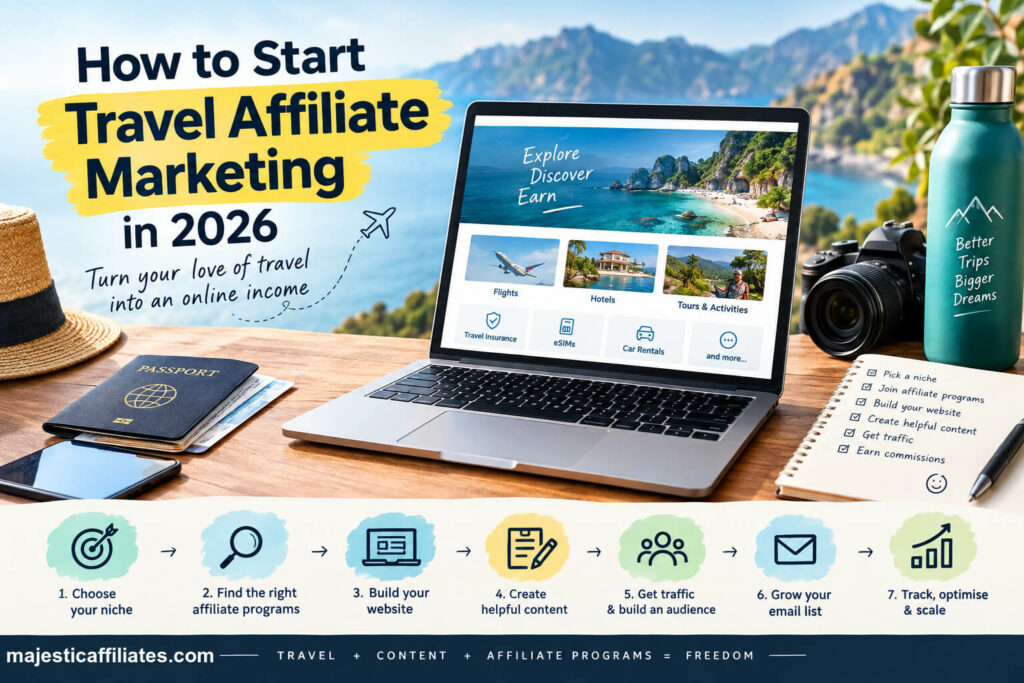
In this guide, I’ll show you how to start travel affiliate marketing in 2026, including how to choose a niche, find affiliate programs, create a website, get traffic, build an email list and turn visitors into commissions.
Quick answer: The simplest way to start is to choose a specific travel niche, build a useful website or content platform around it, join relevant travel affiliate programs, publish helpful search-focused content and promote your affiliate offers naturally.
What Is Travel Affiliate Marketing?
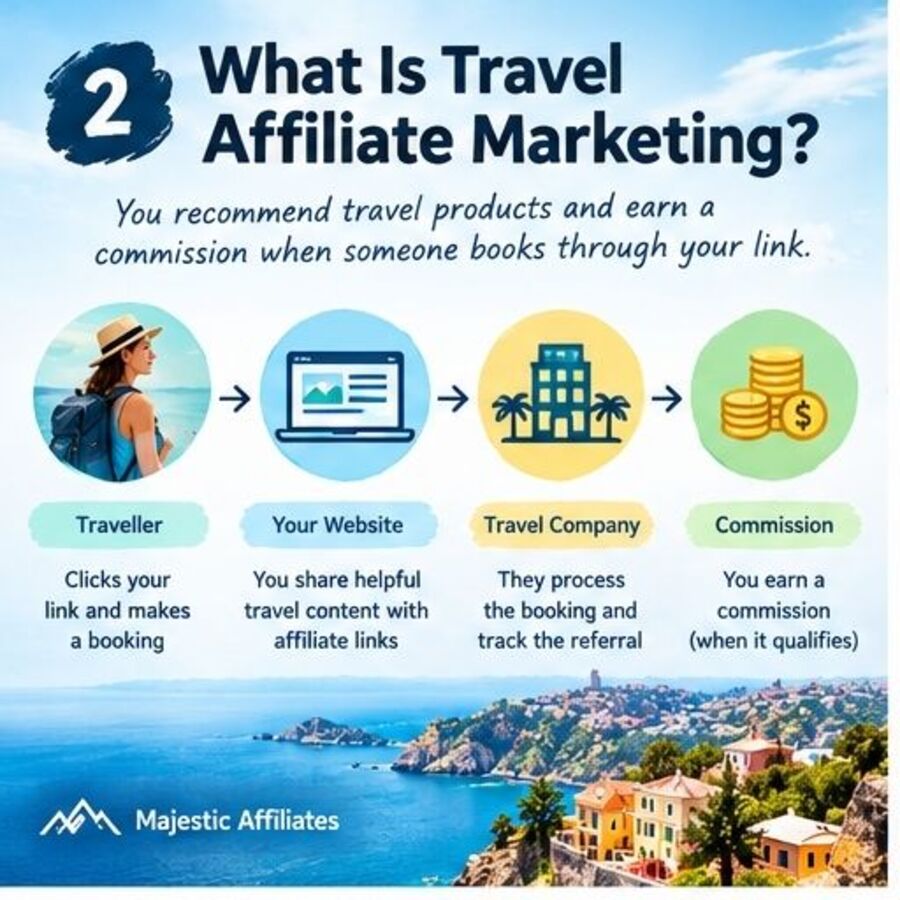
Travel affiliate marketing is a business model where you promote travel-related products or services from another company.
You receive a unique affiliate link. When someone clicks your link and completes a qualifying action, you can earn a commission.
For example, imagine you create a travel website focused on European holidays.
You publish an article called:
“10 Best Hotels in Rome for First-Time Visitors.”
Within the article, you recommend suitable hotels and provide links to a hotel booking platform.
A reader clicks your link, books their accommodation and the affiliate program records the referral.
You earn a commission according to that program’s terms.
The same basic model can work with:
- Hotels
- Vacation rentals
- Flights
- Tours
- Attractions
- Travel insurance
- Car rentals
- Cruises
- eSIMs
- Travel gear
- Luggage
- Travel cards
- Airport transfers
- Travel experiences
- Travel packages
The exact commission, cookie period and qualifying action vary considerably between programs, so always check the current terms before promoting an offer.
For example, Booking.com currently operates an affiliate partner program for businesses that want to promote its travel inventory.
Is Travel Affiliate Marketing Worth It in 2026?
Yes, but you should approach it as a real content business, rather than a quick-money scheme.
Travel is particularly interesting for affiliate marketers because travellers make purchases at multiple stages of a trip.
Someone planning a holiday might need:
- Inspiration
- Flights
- Accommodation
- Travel insurance
- Airport transportation
- Tours and activities
- eSIM or mobile data
- Car rental
- Travel equipment
That creates multiple opportunities to help the same visitor.
For example, someone searching for:
“7-day Japan itinerary”
could potentially be interested in hotel recommendations, activities, rail travel, insurance and an eSIM.
This is why I wouldn’t build a travel affiliate website around a single affiliate program.
Instead, build an audience and content ecosystem where several relevant affiliate products can solve different problems.
Step 1: Choose a Travel Niche
One of the biggest mistakes beginners make is starting with something too broad.
Don’t simply create:
“My Travel Blog.”
You’re competing with enormous travel websites, tourism companies, newspapers and established publishers.
Instead, start with a more specific audience.
For example:
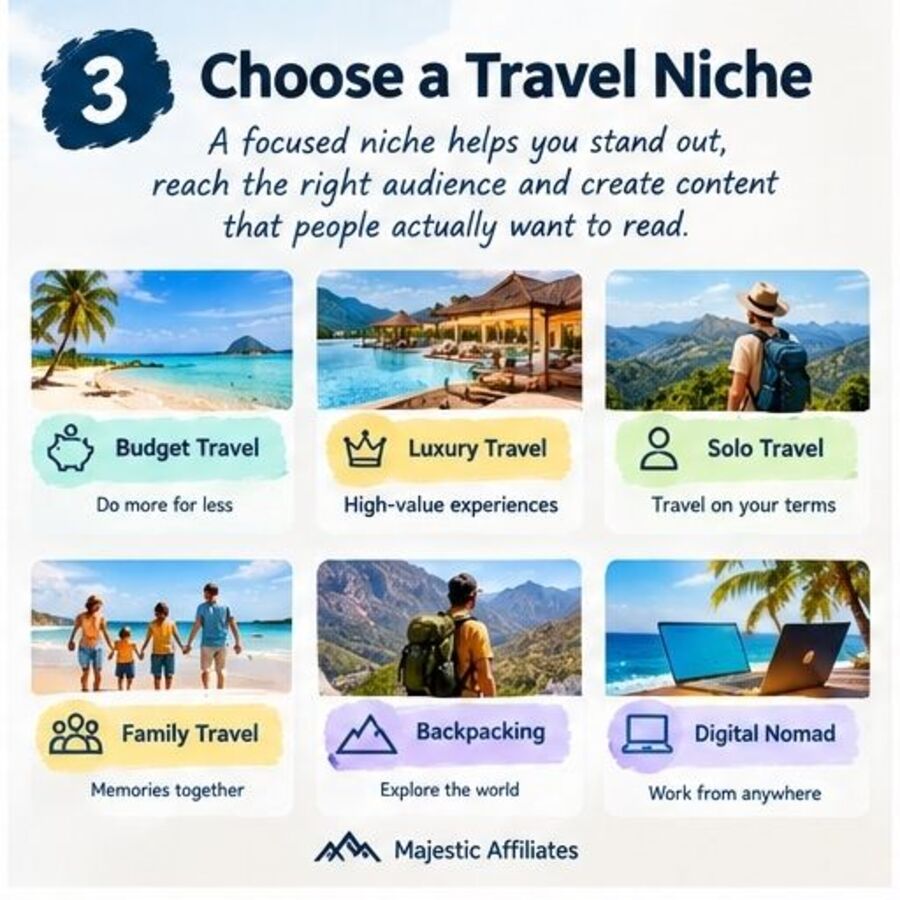
- Budget travel
- Luxury travel
- Solo travel
- Family travel
- Backpacking
- Digital nomad travel
- Adventure travel
- Weekend breaks
- European travel
- UK travel
- Travel for students
- Couples travel
- Accessible travel
- Travel for retirees
You can become more specific still.
For example:
Budget travel for European weekend breaks
is much more focused than:
Travel.
A specific niche also makes it easier to understand what your audience wants.
A simple niche formula
Try:
Audience + destination + problem
For example:
- Budget travellers + Europe + finding cheap accommodation
- Digital nomads + Southeast Asia + staying connected
- Families + Spain + finding family-friendly hotels
- Backpackers + Thailand + organising affordable trips
You don’t necessarily need to stay this narrow forever.
Start focused, establish authority and expand when you have traffic and data.
Step 2: Research Your Audience
Before joining affiliate programs, understand what your potential audience actually searches for.
Ask:
What problems does my audience have before, during and after a trip?
For example, a family travelling to Italy might search for:
- Best family hotels in Rome
- Best hotels near the Colosseum
- Things to do in Rome with kids
- Italy travel insurance
- Italy eSIM
- Car rental in Italy
- Best day trips from Rome
- Best tours in Florence
These searches can become your content strategy.
The important point is that you’re not simply creating articles because you found an affiliate program.
You’re starting with the traveller’s problem and then finding an appropriate solution.
Step 3: Choose Your Travel Affiliate Programs
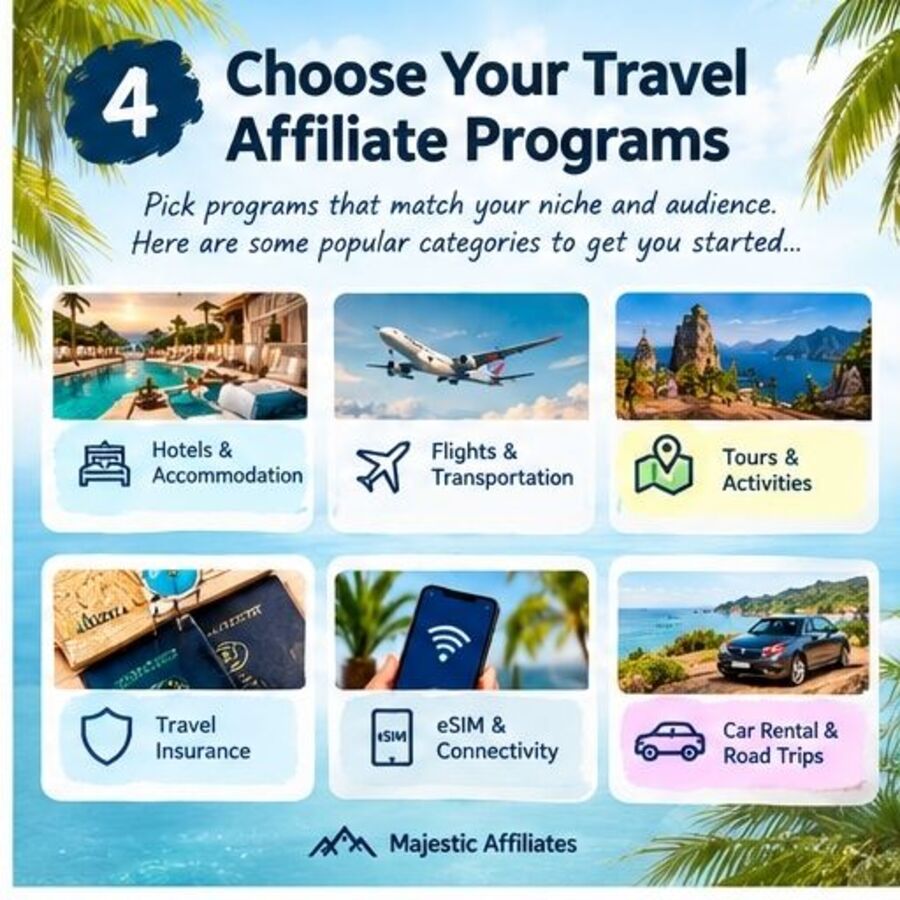
Once you know your niche, find affiliate programs that match your audience.
Don’t automatically choose the program offering the highest commission.
A program paying 10% can sometimes be more valuable than one paying 30% if the product has a much better conversion rate, higher order value or stronger brand recognition.
Look at:
- Commission rate
- Average order value
- Cookie duration
- Conversion potential
- Brand reputation
- Product relevance
- Payment terms
- Geographic availability
- Affiliate tracking
- Promotional resources
- Recurring commissions, where available
For example, travel affiliate opportunities can include hotel booking platforms, activity providers, insurance companies, car rental companies and eSIM providers.
You can use your main guide, 55 Best Travel Affiliate Programs in 2026, as your starting point for researching different categories.
The goal isn’t to join 50 programs immediately.
Start with perhaps 3–5 highly relevant programs.
For example:
Travel website focused on digital nomads
- Accommodation affiliate
- eSIM affiliate
- Travel insurance affiliate
- Tours/activities affiliate
- Travel gear affiliate
That’s enough to get started.
Step 4: Build a Travel Affiliate Website
Although you can promote affiliate products through social media, video and other channels, I recommend beginners consider building a website.
Get the Tools to Build Multiple Income Streams
Website hosting, email marketing tools, affiliate program directories, and training on how to diversify your revenue—all inside Wealthy Affiliate for $49/month.
Get All the Tools You Need →Why?
Because a website gives you an asset that you control.
You can publish:
- Guides
- Reviews
- Comparisons
- Destination articles
- Itineraries
- Travel checklists
- FAQs
- Tutorials
- Email signup pages
And your content can potentially continue attracting search traffic long after publication.
Your basic setup doesn’t need to be complicated.
You’ll need:
1. Domain name
Choose something memorable and relevant to your brand.
2. Web hosting
Choose reliable hosting that can handle your expected traffic.
3. WordPress or another suitable CMS
WordPress is a practical choice for many beginners because it gives you considerable flexibility.
4. Professional design
Your site doesn’t need to be fancy.
It needs to be:
- Fast
- Mobile-friendly
- Easy to navigate
- Easy to read
- Trustworthy
- Secure
5. Essential pages
At minimum, consider:
- About
- Contact
- Privacy Policy
- Affiliate Disclosure
- Terms & Conditions
Your affiliate disclosure is particularly important. Readers should understand when you may earn a commission from links.
Step 5: Create Your Content Strategy
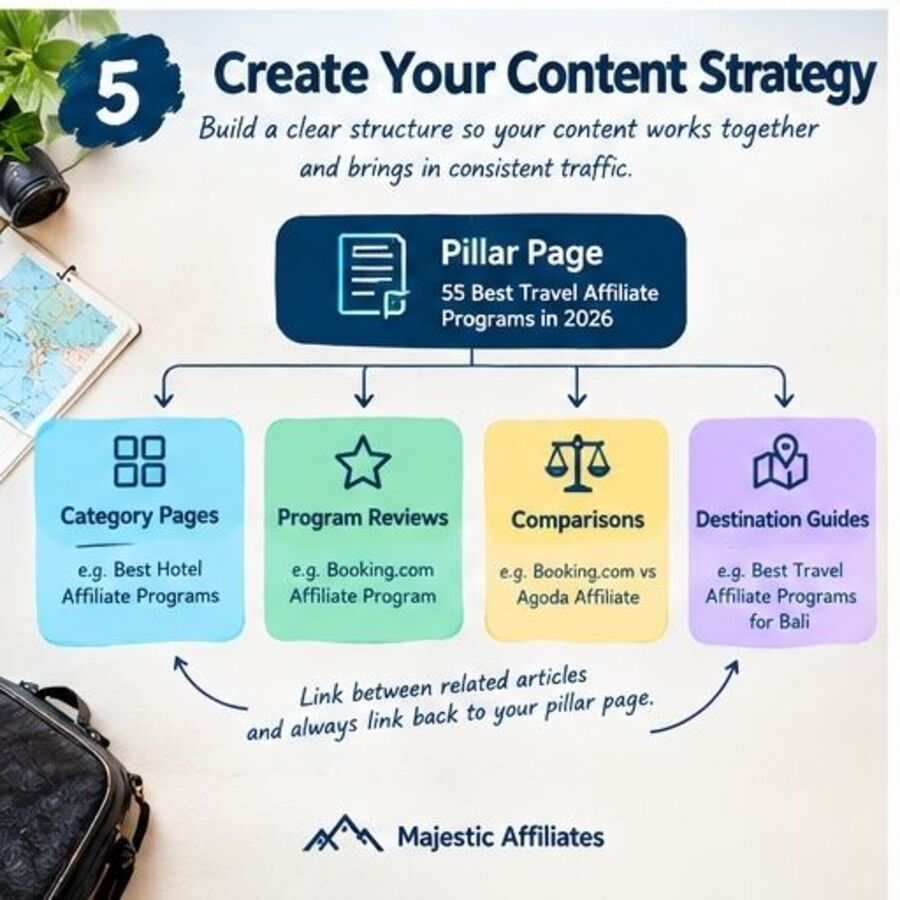
This is where your travel affiliate business really starts.
Don’t publish random travel articles.
Build content clusters around your niche.
For example, imagine your website focuses on travel to Japan.
Your main hub could be:
Japan Travel Guide
Then supporting content could include:
Accommodation
- Best Hotels in Tokyo
- Best Hotels in Kyoto
- Best Budget Hotels in Osaka
Activities
- Best Tokyo Tours
- Best Things to Do in Kyoto
- Best Day Trips From Tokyo
Travel essentials
- Best Japan Travel Insurance
- Best Japan eSIM
- Japan Travel Apps You Need
Planning
- Japan 7-Day Itinerary
- Japan 14-Day Itinerary
- How Much Does a Trip to Japan Cost?
This creates a website where articles support one another.
Step 6: Target Commercial Keywords
Not every keyword is equally valuable.
🎓 Ready to Access This Training?
Start learning today with no financial risk
Join Free – No Credit Card RequiredCompare:
“History of Japan”
with:
“Best eSIM for Japan.”
The first search may be informational.
The second has much stronger commercial intent.
For affiliate marketing, you want a healthy mixture of informational and commercial content.
Informational keywords
Examples:
- How to plan a trip to Japan
- Best time to visit Japan
- What to pack for Japan
- How many days do you need in Japan?
Commercial keywords
Examples:
- Best hotels in Tokyo
- Best Japan eSIM
- Best travel insurance for Japan
- Best Tokyo tours
- Japan hotel comparison
Comparison keywords
Examples:
- Airalo vs Holafly
- Booking.com vs Agoda
- Viator vs GetYourGuide
The commercial and comparison articles can be particularly valuable because the reader is often closer to making a purchase.
Step 7: Create Content That Adds Real Value
This is extremely important in 2026.
🤔 Still Unsure If It’s Right for You?
The free starter account answers this question. Spend 3-7 days inside:
- Take the first 10 lessons
- Build your starter website
- Ask questions in the community
- Browse the training library
- Feel out the vibe
If it clicks? Upgrade. If not? Walk away. You’ve lost nothing.
Don’t create pages that simply copy information from an affiliate company’s website and add affiliate links.
Google specifically warns about thin affiliate content. Good affiliate websites should add meaningful value through things such as original information, comparisons, reviews, useful navigation, ratings or additional analysis.
Google also warns against scaled content created primarily to manipulate search rankings rather than help users. That applies regardless of whether the content was produced manually or with AI.
So if you use AI to help with your content, don’t simply generate 100 articles and publish them untouched.
Use AI to help with:
- Research organisation
- Outlines
- Brainstorming
- First drafts
- Editing
- Content refreshes
- FAQs
- Social media ideas
Then add your own expertise, examples, comparisons, opinions and useful information.
A good affiliate article should answer:
“Why should I trust you?”
Give readers a reason.
That could include:
- Your own experience
- Original research
- Screenshots
- Comparisons
- Pros and cons
- Pricing explanations
- Who the product is suitable for
- Who should avoid it
- Alternative options
- Practical tips
- Updated information
Step 8: Use SEO to Get Traffic
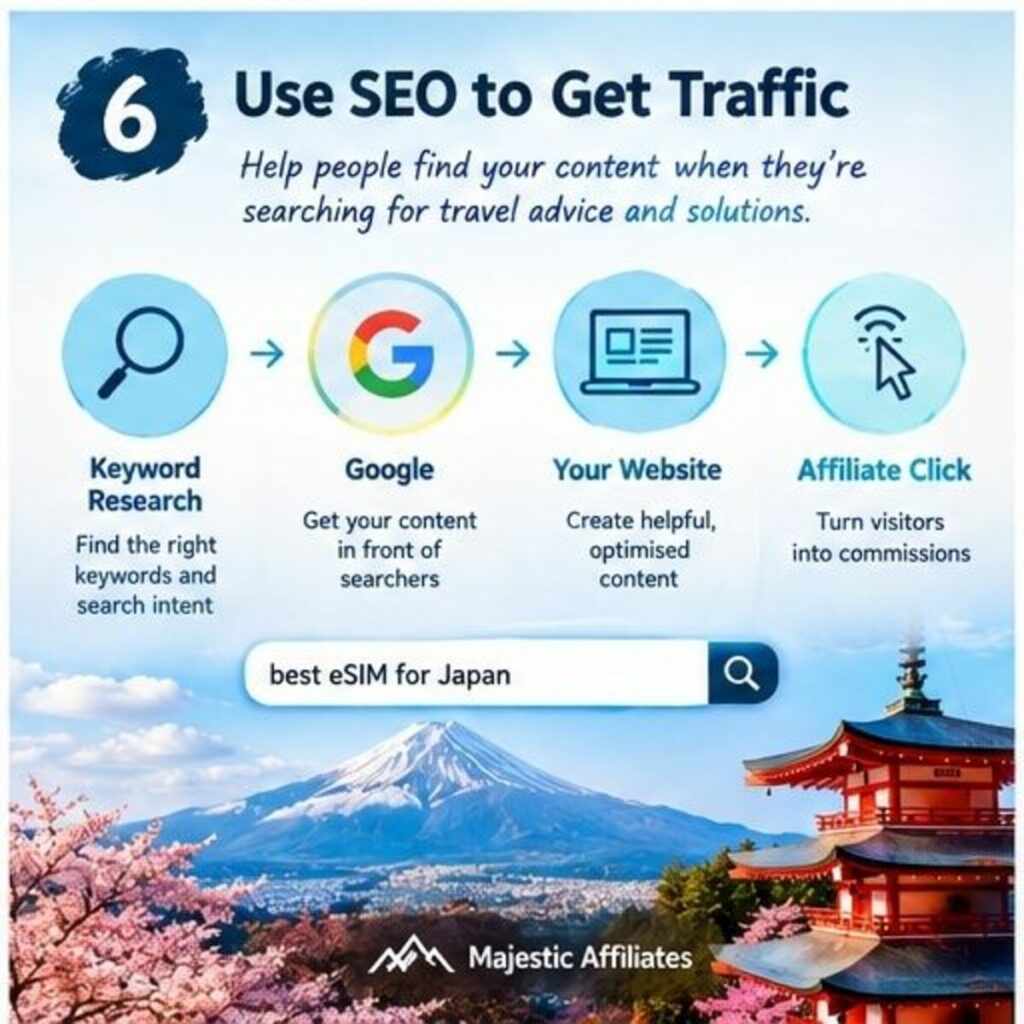
SEO can be one of the most powerful traffic sources for a travel affiliate website.
But don’t think of SEO as simply putting a keyword into an article 20 times.
Instead, create the best useful answer for the searcher’s question.
Start by researching:
- Primary keyword
- Search intent
- Related questions
- Competing pages
- Content gaps
- Supporting keywords
- Internal linking opportunities
Then create a comprehensive article.
For example, instead of writing a thin:
“Best Travel Insurance”
article, create something genuinely useful:
Best Travel Insurance for Backpackers in 2026
Then explain:
- What backpackers should look for
- Medical coverage
- Trip cancellation
- Baggage protection
- Adventure activities
- Long-term travel
- Existing exclusions
- Different types of policies
- How to compare providers
That is far more useful than simply listing affiliate links.
Master SEO & Traffic Generation
Learn how to rank in Google, drive consistent organic traffic, and diversify your traffic sources. Get access to keyword research tools and SEO training inside Wealthy Affiliate.
Access SEO Training FREE →Step 9: Build Internal Links
Internal linking is particularly important when you’re building a travel affiliate content site.
Imagine your main article is:
55 Best Travel Affiliate Programs in 2026
You can link from it to:
- Best Hotel Affiliate Programs
- Best Flight Affiliate Programs
- Best Tour Affiliate Programs
- Best Travel Insurance Affiliate Programs
- Best eSIM Affiliate Programs
- Best Car Rental Affiliate Programs
Then those articles can link to individual program reviews.
For example:
Best Travel Insurance Affiliate Programs
→ SafetyWing Review
→ World Nomads Review
→ Travel Insurance Comparison
This creates a logical topical structure.
A simple rule is:
Pillar → Category → Individual Program → Comparison
And don’t forget to link back upward.
Step 10: Build an Email List
Don’t rely entirely on Google.
Search algorithms change.
Social platforms change.
Your email list is an audience you can communicate with directly.
Create a useful free resource that solves a travel problem.
For example:
Free Travel Lead Magnet
“The Ultimate Travel Planning Checklist”
It could include:
- Flight checklist
- Hotel checklist
- Insurance checklist
- Passport/visa checklist
- Packing checklist
- Mobile/eSIM checklist
- Airport checklist
- Pre-departure checklist
Ask visitors for their email address in exchange for the download.
Then create a simple welcome sequence.
Example email funnel
Email 1: Deliver the checklist
Email 2: Common travel planning mistakes
Email 3: How to save money when booking accommodation
Email 4: Travel insurance mistakes to avoid
Email 5: How to stay connected abroad
Email 6: Useful travel tools and resources
Email 7: Recommended travel services
The key is to help first and sell second.
Step 11: Use Pinterest, YouTube Shorts and Social Media
SEO shouldn’t be your only traffic strategy.
Travel is naturally visual, which makes social platforms particularly useful.
You could turn one article into:
- Pinterest pins
- Instagram Reels
- TikTok videos
- YouTube Shorts
- Facebook posts
- Carousels
- Infographics
- Email content
For example, one article:
“10 Things to Know Before Visiting Japan”
could become:
Short 1: 3 mistakes first-time visitors make
Short 2: How much cash should you carry?
Short 3: Best Japan eSIM options
Pinterest Pin: Japan travel checklist
Facebook post: 10 things I wish I knew before visiting Japan
Every piece of content can lead people back to your website.
Step 12: Track Your Affiliate Clicks and Sales
Don’t guess what’s working.
Build Your Sustainable Business Starting TODAY
You have the blueprint. Now get the training, tools, hosting, and community support to build something that lasts.
JOIN 2.9 MILLION+ AFFILIATE MARKETERS:
Track your results.
At minimum, monitor:
- Website visitors
- Top landing pages
- Affiliate clicks
- Click-through rate
- Affiliate conversions
- Earnings
- Earnings per click
- Top-performing programs
- Top-performing articles
After several months, you may discover something interesting.
Perhaps your:
“Best Hotels in Rome”
article gets 5,000 visitors but produces relatively few commissions.
Meanwhile:
“Best eSIM for Italy”
gets only 1,000 visitors but generates significantly more revenue.
That information should influence your future content strategy.
Step 13: Update Your Content Regularly
Travel information changes.
Affiliate programs change.
Prices change.
Commission structures change.
Companies change their policies.
Destinations change.
Your content therefore shouldn’t be treated as “publish once and forget.”
Create a content refresh schedule.
For important pages, check:
- Affiliate links
- Program availability
- Commission information
- Prices
- Product features
- Screenshots
- Outdated recommendations
- Broken links
- Search rankings
- Conversion rates
Google’s current search guidance continues to emphasise useful, original content, and its documentation also warns against creating large volumes of low-value pages simply to manipulate rankings.
How Much Money Can You Make With Travel Affiliate Marketing?
There isn’t a guaranteed income level.
Your earnings depend on factors such as:
Traffic × Click-through rate × Conversion rate × Average commission
For example, suppose a website receives 20,000 relevant visitors per month.
If 5% click an affiliate link:
20,000 × 5% = 1,000 affiliate clicks
If 4% of those clicks convert:
1,000 × 4% = 40 conversions
If the average commission is £15:
40 × £15 = £600/month
That’s only an example, not a typical or guaranteed result.
The numbers can be dramatically different depending on the niche and affiliate program.
This is why I would focus less on promises such as “make £10,000 a month” and more on building a system that steadily increases:
Traffic → Trust → Clicks → Conversions → Revenue
The Best Travel Affiliate Marketing Strategy for Beginners
If I were starting a travel affiliate website from scratch in 2026, I wouldn’t try to cover every travel topic immediately.
I’d use this approach:
Month 1
Choose a niche and build the website.
Create:
- About page
- Affiliate disclosure
- Email signup
- 5–10 foundational articles
Month 2
Publish another 8–12 useful articles.
Focus on informational and low-to-medium competition keywords.
Join several relevant affiliate programs.
Month 3
Start publishing commercial content.
Create:
- Best X
- X reviews
- X vs Y
- Alternatives to X
- Buying/planning guides
Months 4–6
Increase publishing consistency.
Start building:
- Pinterest traffic
- Short-form video
- Email subscribers
- Internal links
- Backlinks/mentions
- Original resources
Months 6–12
Analyse what is working.
Then double down on:
- Pages getting traffic
- Pages generating affiliate clicks
- Programs generating sales
- Keywords you are beginning to rank for
- Topics your audience responds to
You don’t need hundreds of articles to begin.
You need the right articles for the right audience.
Common Travel Affiliate Marketing Mistakes
1. Choosing a niche that’s too broad
Trying to compete with huge travel publishers from day one makes the job unnecessarily difficult.
Start focused.
2. Chasing commission percentages
A 30% commission doesn’t automatically make something a better affiliate offer than a 5% commission.
Look at the entire economics of the offer.
3. Publishing hundreds of AI-generated articles
More content isn’t automatically better.
Google specifically identifies scaled content abuse as a problem when large amounts of unoriginal content are produced primarily for search manipulation.
4. Copying merchant descriptions
Don’t simply copy the description supplied by an affiliate company.
Add your own analysis.
5. Ignoring commercial intent
Informational content can bring traffic, but commercial content is what gives many affiliate websites their monetisation opportunities.
6. Having no email list
Don’t wait until you have thousands of visitors.
Start collecting email subscribers as early as practical.
7. Relying on Google alone
Build multiple traffic sources.
SEO, Pinterest, YouTube, social media and email can complement one another.
8. Forgetting to disclose affiliate relationships
Be transparent with your readers about affiliate links and commissions.
Trust is one of your most valuable assets.
How to Scale a Travel Affiliate Website
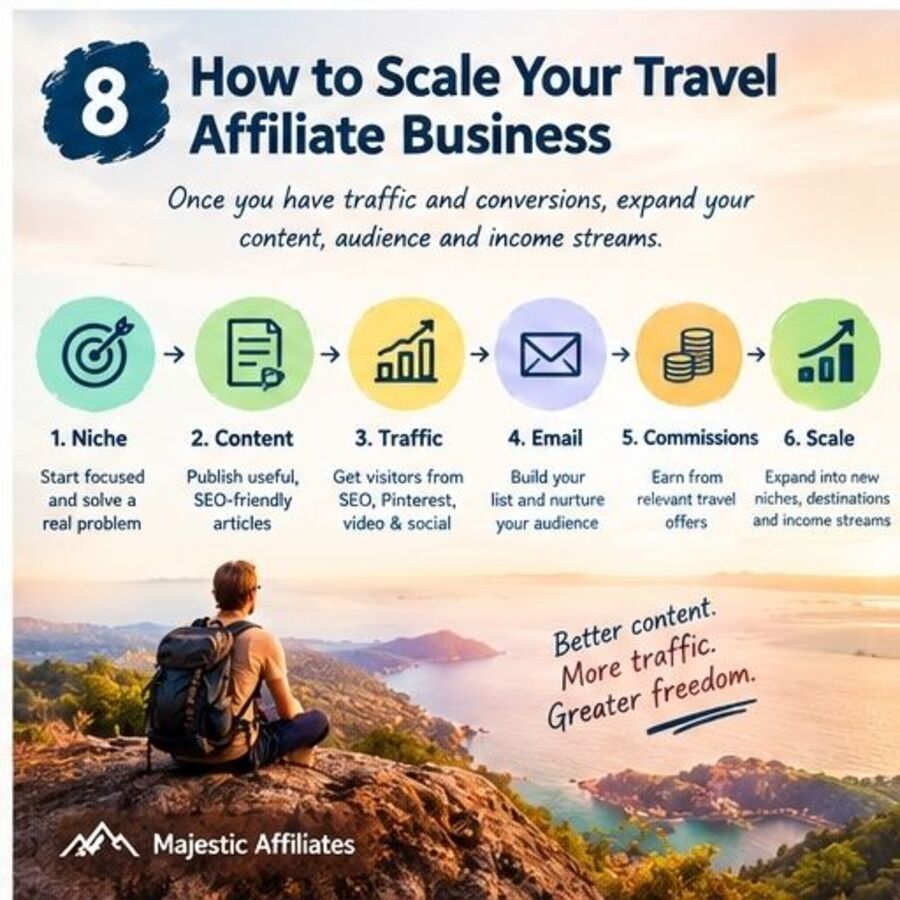
Once you have established traffic and conversions, you can expand.
For example:
Stage 1 – One niche
Budget European travel
↓
Stage 2 – Multiple content categories
Hotels
Flights
Insurance
eSIMs
Tours
↓
Stage 3 – Multiple destinations
Spain
Italy
Greece
France
Portugal
↓
Stage 4 – Multiple traffic channels
Google
Pinterest
YouTube
Facebook
Email
↓
Stage 5 – Additional monetisation
Affiliate commissions
Display advertising
Sponsored content
Digital products
Travel guides
Email sponsorships
Brand partnerships
This is how you move from simply having a travel blog to building a diversified travel media business.
What Are the Best Travel Affiliate Programs to Start With?
There isn’t one universal “best” program.
The right programs depend on your audience.
For example:
Hotel-focused website
Look at hotel booking and accommodation affiliate programs.
Adventure travel website
Consider tours, activities and adventure travel companies.
Digital nomad website
Consider:
- eSIMs
- Travel insurance
- Accommodation
- Co-working services
- Travel tools
Luxury travel website
Look for:
- Luxury hotels
- Villas
- Private aviation
- Luxury experiences
- High-value travel services
Budget travel website
Consider:
- Budget accommodation
- Cheap flights
- Hostels
- Travel insurance
- Affordable activities
- Travel cards and useful travel products
The best affiliate program is usually the one that solves a problem your audience already has.
Travel Affiliate Marketing in 2026: What Has Changed?
One of the biggest changes is the importance of creating content that offers something genuinely useful rather than simply targeting keywords.
Search is also becoming increasingly diverse, with traditional results existing alongside AI-powered search experiences and other specialised search features.
Google’s 2026 documentation specifically discusses optimisation for generative AI features and stresses the continuing importance of non-commodity content and established SEO best practices.
That means your strategy shouldn’t be:
Keyword → AI article → affiliate links → publish
Instead, think:
Audience problem → research → genuinely useful content → trust → relevant recommendation → affiliate conversion
That is a much stronger long-term business model.
Your Travel Affiliate Marketing Action Plan
If you’re ready to start, here’s the simple version.
Step 1
Choose a specific travel niche.
Step 2
Research your audience and their problems.
Step 3
Find 3–5 relevant affiliate programs.
Step 4
Build your website.
Step 5
Create your core website pages.
Step 6
Research keywords and search intent.
Step 7
Publish genuinely helpful informational content.
Step 8
Add commercial articles and product comparisons.
Step 9
Build an email list.
Step 10
Promote your content through SEO, Pinterest, video and social media.
Step 11
Track clicks, conversions and revenue.
Step 12
Update successful content and expand into related topics.
Final Thoughts
Learning how to start travel affiliate marketing in 2026 isn’t particularly difficult.
Building a successful travel affiliate business is harder – but that’s actually good news.
It means there is a significant difference between someone who publishes a few generic articles with affiliate links and someone who builds a genuinely useful travel resource.
You don’t need to start with 1,000 articles.
You don’t need to join every affiliate program.
And you certainly don’t need to wait until everything is perfect.
Start with one audience, one niche and a handful of useful affiliate products.
Then build from there.
The long-term goal is to create a website that travellers trust before they make a booking.
Once you achieve that, affiliate marketing becomes much more than placing links on blog posts. It becomes a scalable content business.
Frequently Asked Questions
Is travel affiliate marketing profitable?
It can be profitable, but there are no guaranteed earnings. Your results depend on traffic quality, content, affiliate offers, conversion rates and the commissions available.
Can I start travel affiliate marketing without travelling?
Yes. You don’t necessarily need to travel constantly to operate a travel affiliate website. However, you should be careful not to imply personal experience you don’t have. Use reliable research, clearly explain your methodology and add genuine value.
Do I need a website for travel affiliate marketing?
No, but a website can be extremely useful because it gives you a central place to publish content, capture email subscribers and organise your affiliate recommendations.
How much does it cost to start travel affiliate marketing?
You can start relatively cheaply with a domain, hosting and basic website setup. The bigger investment is usually your time: researching keywords, creating useful content, building an audience and improving your website.
What is the best travel affiliate program for beginners?
There isn’t one program that is best for everyone. Start with programs that closely match your niche and audience. Hotel, activities, insurance, car rental and eSIM programs can all be relevant depending on the type of traveller you’re targeting.
Can I use AI to create travel affiliate content?
Yes, AI can be useful for research, brainstorming, outlining and editing. However, don’t use it as a shortcut to mass-produce low-value pages. Google’s current spam policies specifically warn against scaled content abuse, including large amounts of unoriginal content created primarily to manipulate search rankings.
How long does travel affiliate marketing take to make money?
There is no fixed timeframe. A new website may take months to build meaningful organic traffic, while an established website with an existing audience can potentially generate commissions much sooner. Focus on building traffic and trust rather than expecting instant income.
Ready to Find Travel Affiliate Programs?
Once you’ve chosen your niche, the next step is finding affiliate programs that actually fit your audience.
I’ve put together a comprehensive guide covering 55 travel affiliate programs, including hotels, flights, tours, car rentals, travel insurance, eSIMs, luxury travel and more.
Start there, shortlist the programs relevant to your audience, and then build your content strategy around them.
Disclosure: This article contains affiliate links. Commission rates and programme details are verified as of May 2026 and are subject to change. Always verify current terms directly with each programme before publishing. We only recommend programmes we genuinely believe are valuable to travel content creators.
Related Articles:
- Wealthy Affiliate Review 2026: 10-Year Member’s Honest Take
- Affiliate Marketing for Beginners: Complete Guide
- How to Write Product Reviews That Convert
- How to Choose a Profitable Affiliate Niche in 2026
- 11 Top Affiliate Programs to Join in 2026
- How to Build a Sustainable Affiliate Marketing Business