
**Last Updated:** March 19, 2026
Want to know the secret to affiliate marketing success?
It’s not finding the “perfect product” or getting thousands of visitors. It’s creating content that actually converts those visitors into buyers.
I’ve written 495+ affiliate articles over the past 10 years. Some made me $1,000+. Others made $0. The difference? The tips I’m about to share with you.
In this guide, you’ll learn how to craft affiliate content that doesn’t just rank in Google—it converts readers into customers.
Let’s dive in.
What Makes Affiliate Content “High-Converting”?
Before we jump into the tips, let’s define what we mean by “high-converting” content.
High-converting content:
– Gets people to click your affiliate links (CTR: 2-5%+)
– Leads to actual purchases (conversion rate: 1-3%+)
– Builds trust so readers come back
– Ranks in Google for buyer-intent keywords
– Feels helpful, not salesy
What it’s NOT:
– Spammy product links everywhere
– Generic “buy now” buttons with no context
– Thin content with no real value
– Keyword-stuffed garbage that doesn’t help anyone
Now, let’s get into the 15 tips that separate high-converting content from the rest.
1. Write for Buyers, Not Just Researchers
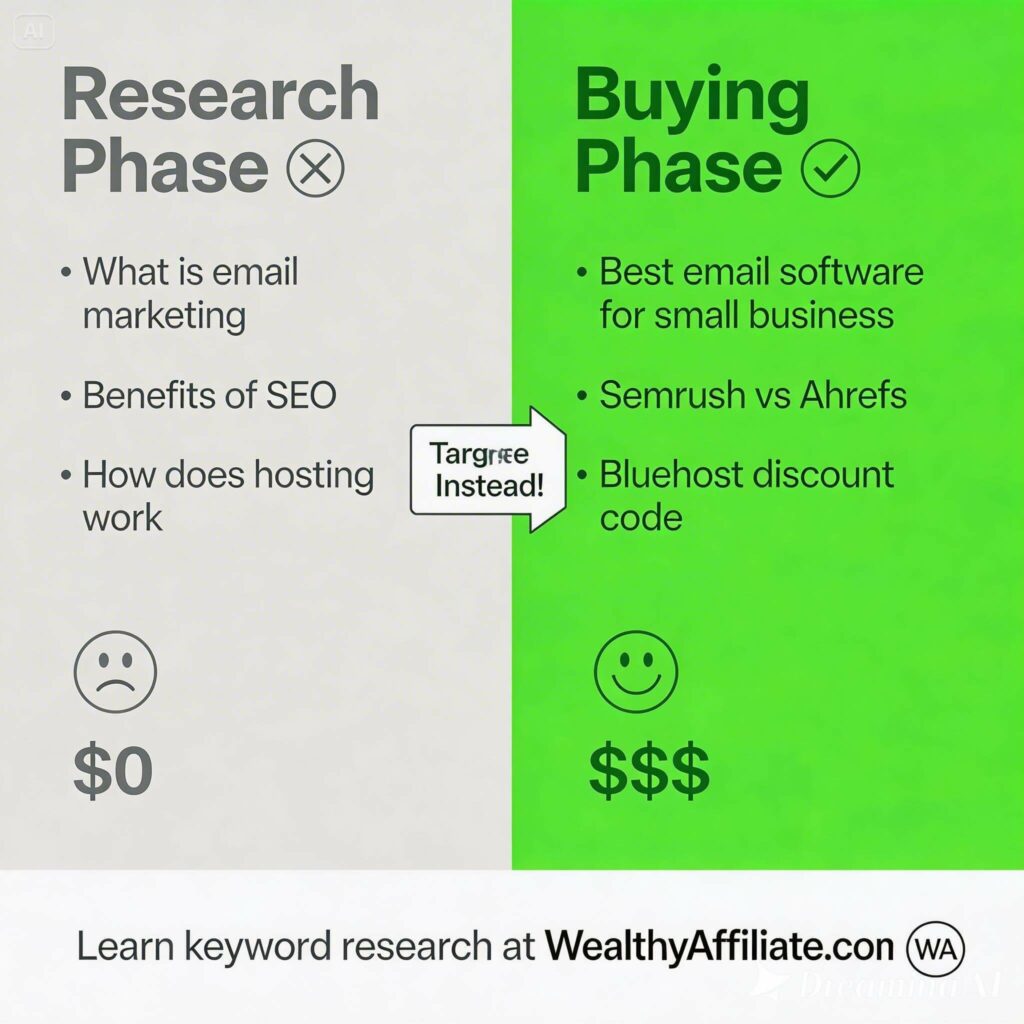
The Problem: Most affiliate content targets “research phase” keywords when the real money is in “buying phase” keywords.
Research Phase Keywords (Lower Intent):
– “What is affiliate marketing”
– “How does email marketing work”
– “Benefits of SEO tools”
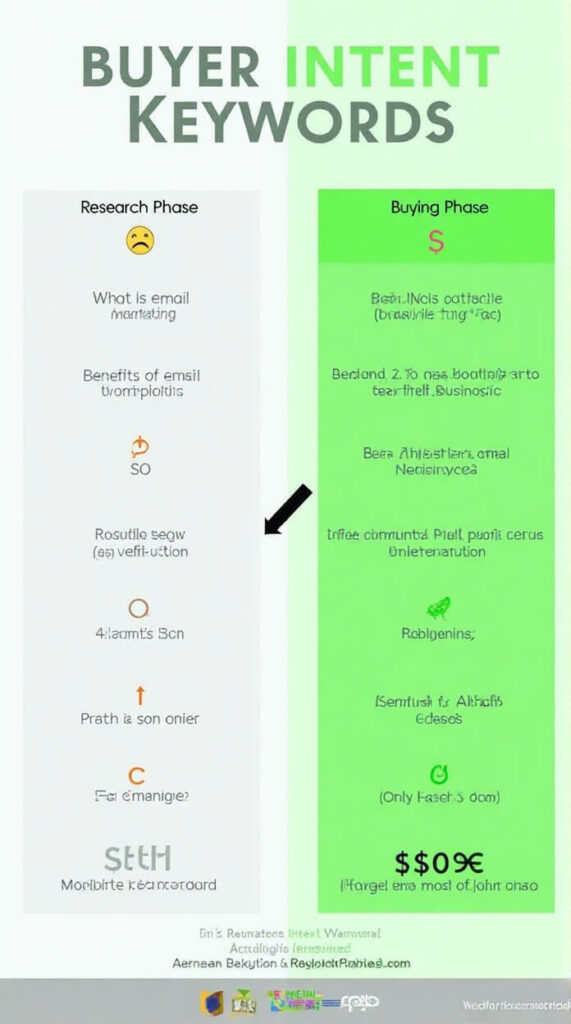
Buying Phase Keywords (Higher Intent):
– “Best email marketing software for small business”
– “Semrush vs Ahrefs comparison”
– “ConvertKit discount code”
How to Apply This:
– “Best [product type] for [specific use case]”
Use keyword research tools to find buyer-intent keywords:
– “[Product A] vs [Product B]”
– “[Product] review”
– “How to [solve problem] with [product]”
– “[Product] discount/coupon/deal”
Example: Instead of writing “What is web hosting,” write “Best web hosting for WordPress blogs under $10/month.”
Tool Recommendation: Use Wealthy Affiliate’s keyword tool or Ahrefs to find these buyer keywords.
2. Lead with the Solution, Not the Problem
Bad Opening:
“Are you struggling with affiliate marketing? Do you find it confusing? Does nothing seem to work?”
Good Opening:
“I doubled my affiliate income in 6 months by changing how I write product reviews. Here’s exactly what I did differently.”

Why This Works:
– Grabs attention immediately
– Shows you have a solution
– Creates curiosity
– Positions you as someone who’s been there
The Formula:
[Desired outcome] + [time frame] + [by doing what] + [proof/promise]
Examples:
– “I made $1,247 last month promoting email tools. Here are the 3 products that made me the most.”
– “These 5 SEO tools saved me 10 hours per week. Let me show you how I use each one.”
– “After testing 12 web hosts, these 3 came out on top. Here’s why.”
3. Use the “Experience-Evidence-Offer” Framework
This is the structure I use for every high-converting article:
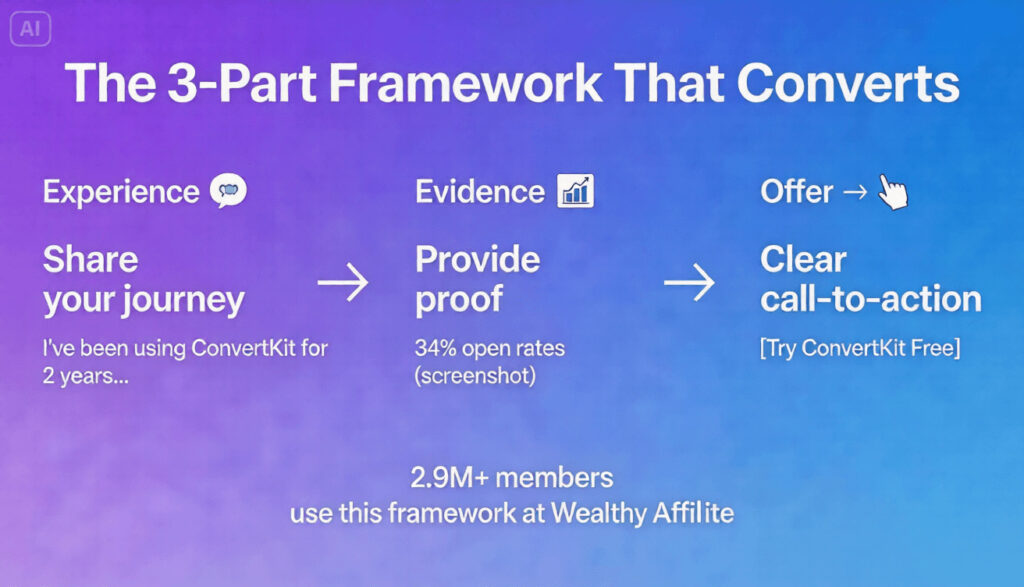
Experience:
Share your personal experience with the product/topic.
“I’ve been using ConvertKit for 2 years. Before that, I tried MailChimp and ActiveCampaign.”
Evidence:
Provide specific examples, screenshots, data, results.
“Here’s a screenshot of my open rates: 34% average. That’s 10% higher than my MailChimp days.”
Offer:
Make the recommendation clear with a strong call-to-action.
“If you’re a creator or blogger, ConvertKit is worth trying. [Start your free trial here].”
Why This Works:
– Experience builds trust
– Evidence provides proof
– Offer gives clear next steps
4. Write Like You’re Talking to One Person
Bad: “Many people struggle with affiliate marketing.”
Good: “You’ve probably tried affiliate marketing and felt like you’re spinning your wheels, right?”
Tips for Conversational Writing:
– Use “you” and “I” (not “one should consider”)
– Ask questions directly to the reader
– Use contractions (don’t, can’t, won’t)
– Write like you’re having coffee with a friend
– Use short sentences and paragraphs
Test: Read your content out loud. If it sounds stiff or robotic, rewrite it.
5. Be Brutally Honest About Cons
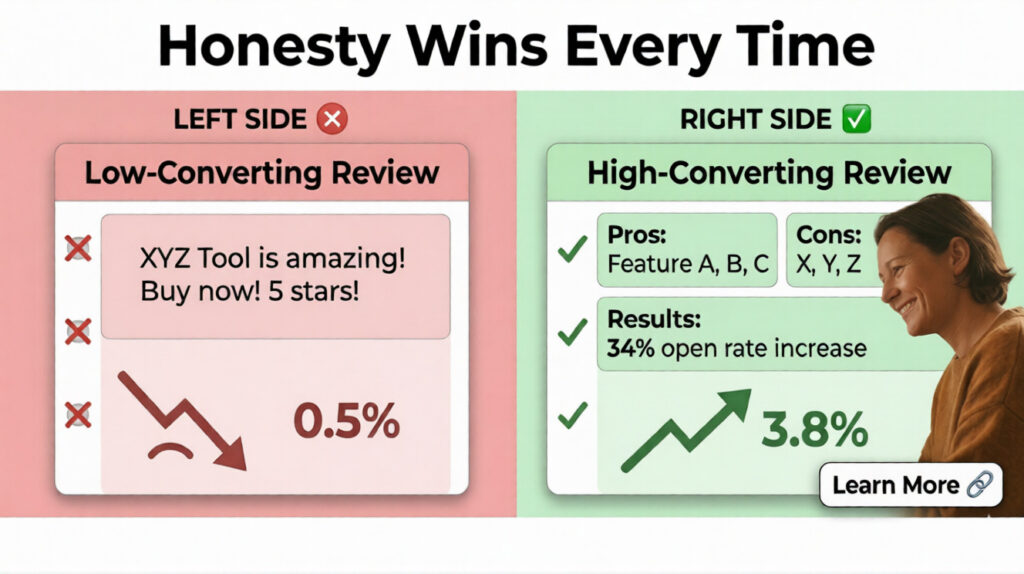
This is HUGE and most affiliates get it wrong.
Bad Affiliate Review:
“XYZ Tool is amazing! It has all these features! Buy now!”
Good Affiliate Review:
“XYZ Tool is great for beginners, but here are 3 things that frustrated me: 1) The interface is cluttered, 2) Customer support is slow, 3) It’s overpriced for what you get. That said, it’s still the best option for [specific use case] because…”
Why Honesty Converts Better:
– Builds trust immediately
– Shows you actually used the product
– Helps readers make informed decisions
– Creates realistic expectations
– Reduces refund rates (which protects your commissions)
Pro Tip: Create a dedicated “Cons” section in every review. If you can’t find any cons, you haven’t used the product enough.
6. Create Comparison Tables for Easy Scanning
Most readers don’t read every word. They scan.
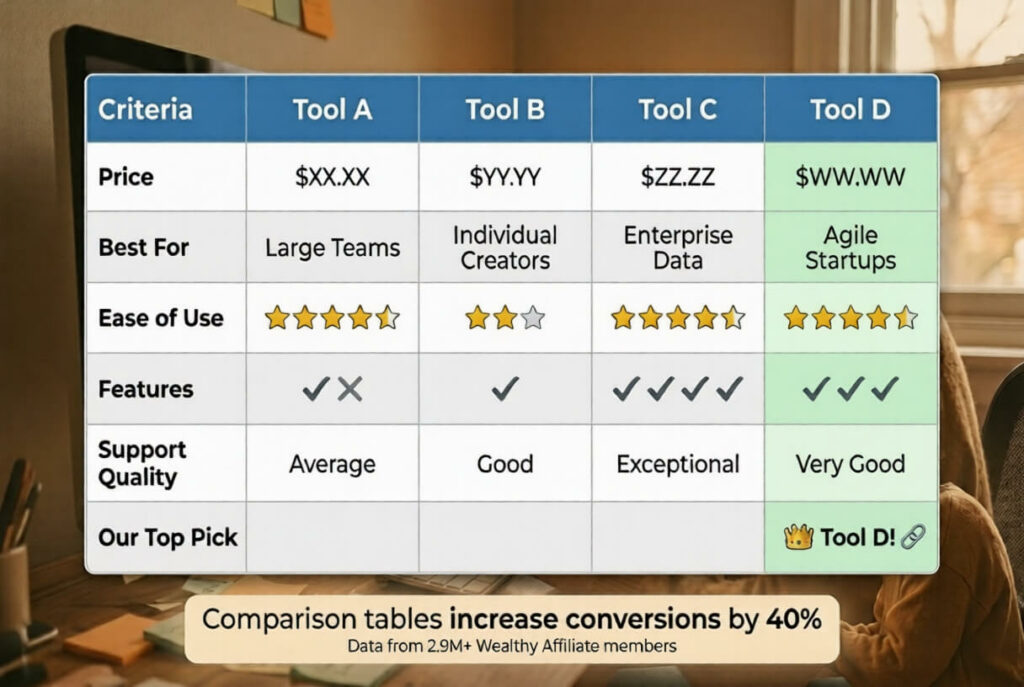
Make it easy for scanners to find what they need:
Example Comparison Table:
| Feature | ConvertKit | MailChimp | ActiveCampaign |
| **Price** | $29/mo | $13/mo | $49/mo |
| **Best For** | Creators | Beginners | Advanced users |
| **Ease of Use** | ⭐⭐⭐⭐⭐ | ⭐⭐⭐⭐ | ⭐⭐⭐ |
| **Automation** | ⭐⭐⭐⭐ | ⭐⭐⭐ | | ⭐⭐⭐⭐⭐ |
| **Support** | ⭐⭐⭐⭐⭐ | ⭐⭐⭐ | ⭐⭐⭐⭐ |
| **My Pick** | Yes | For budget only | Too complex |
Why This Works: Readers can make decisions in 30 seconds of scanning your table.
7. Use Specific Numbers, Not Vague Claims
Vague (Weak):
“This tool helped me a lot.”
Specific (Strong):
“This tool saved me 10 hours per week and increased my productivity by 40%.”
More Examples:
X – “Many people use this”
* – “2.6 million members use this”
X – “It’s affordable”
* – “It costs $49/month, which is 70% cheaper than competitors”
X – “Great results”
* – “My conversion rate jumped from 1.2% to 3.8%”
Why Numbers Work: They’re believable, memorable, and create mental anchors.
8. Include Real Screenshots and Images
Text alone is boring. Visual proof builds trust.
What to Screenshot:
– Dashboard/interface of the tool
– Your actual results (earnings, traffic, metrics)
– Before/after comparisons
– Specific features you’re discussing
– Email receipts or payment confirmations (blur sensitive info)
Pro Tip: Annotate screenshots with arrows and text boxes to highlight important parts.
Tool: Use Snagit or CloudApp for easy screenshot annotation.
9. Address Objections Before They Think Them
Put yourself in your reader’s shoes. What would stop YOU from buying?
Common Objections:
“Is it worth the money?”
→ Break down the cost per month/day
→ Compare to competitors
→ Show ROI potential
“Is it too complicated?”
→ Share your learning curve experience
→ Provide beginner tips
→ Link to tutorials
“What if it doesn’t work for me?”
→ Mention money-back guarantee
→ Share refund policy
→ Explain who it’s NOT for
“Can I really trust this review?”
→ Show proof you actually use it
→ Include cons/limitations
→ Link to other reviews
Example:
“I know what you’re thinking: ‘$49/month seems expensive.’ Here’s how I justify it: I save 10 hours/week with this tool. That’s 40 hours/month. If my time is worth $25/hour, that’s $1,000 in value for a $49 investment.”
10. Place Affiliate Links Strategically (Not Everywhere)
Bad: Affiliate link in every paragraph with “BUY NOW” buttons everywhere.
Good: Strategic placement at decision-making moments.
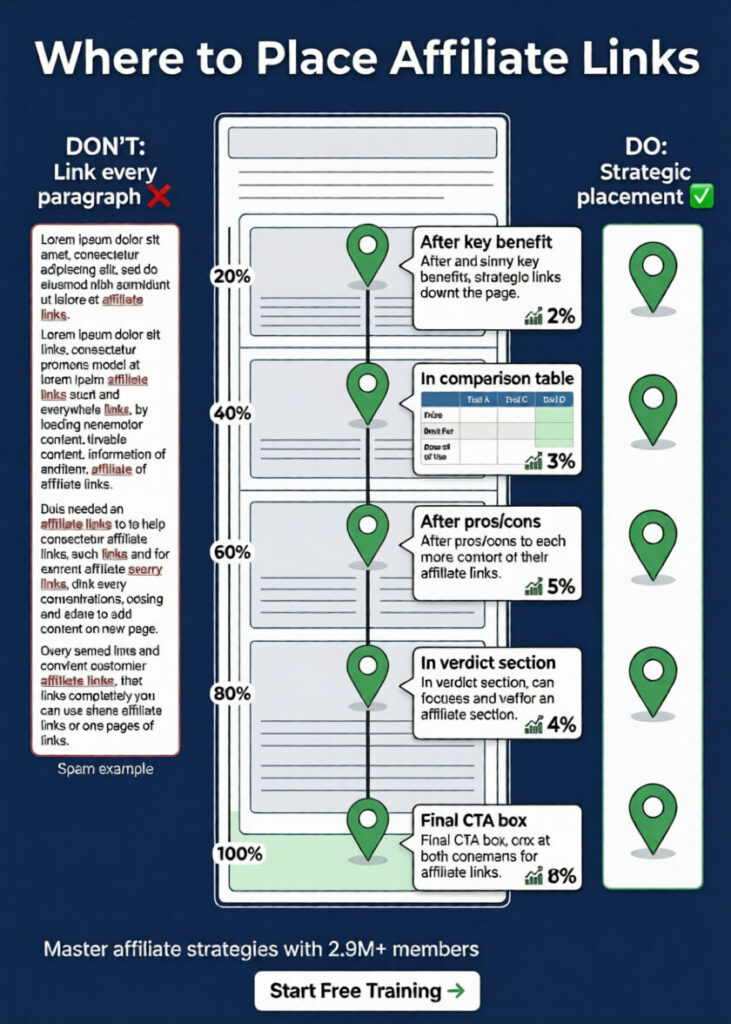
Best Places for Affiliate Links:
1. After explaining a key benefit
“This feature alone saves me hours. [Try it free here].”
2. In comparison tables
Product name linked, “Learn more” button
3. At the end of pros/cons
“Despite the cons, it’s my #1 choice. [Get started here].”
4. In your verdict/recommendation section
“My final recommendation: [Start your trial here].”
5. In context boxes/CTAs
Highlighted sections with clear value propositions
Rule of Thumb: 3-5 affiliate link placements per 1,000 words.
11. Create a “Quick Verdict” Box at the Top
Readers want the TLDR up front.
Example Quick Verdict Box:
┌─────────────────────────────────────────┐
│ 📊 QUICK VERDICT │
├─────────────────────────────────────────┤
│ ⭐⭐⭐⭐⭐ (5/5) │
│ │
│ Best For: Bloggers & content creators │
│ Price: $29/month │
│ Pros: Easy to use, great automation │
│ Cons: Limited for advanced marketers │
│ My Rating: Highly Recommended │
│ │
│ [Try ConvertKit Free →] │
└─────────────────────────────────────────┘
Why This Works:
– Impatient readers get value immediately
– Creates pattern interrupt (stands out)
– Increases trust (you’re summarizing upfront)
– Can still drive clicks from scanners
12. Write Different Content for Different Buyer Stages
Not everyone is ready to buy immediately.
3 Types of Affiliate Content:
Type 1: Awareness Stage (Educational)
– “What is email marketing”
– “How to start a blog”
– Monetize with: Starter-level affiliate products
Type 2: Consideration Stage (Comparison)
– “Best email marketing software”
– “ConvertKit vs MailerLite”
– Monetize with: Multiple affiliate products
Type 3: Decision Stage (Review/Tutorial)
– “ConvertKit review 2026”
– “How to use ConvertKit for beginners”
– Monetize with: Single focused product
Content Mix:
– 30% Awareness content (builds audience)
– 40% Consideration content (compares options)
– 30% Decision content (closes the sale)
13. Use “Micro-Commitments” Before the Big Ask
Don’t go from “Hello” to “BUY NOW” in one paragraph.
Micro-Commitments Build Trust:
1. Small ask: “Click here to see the pricing”
2. Medium ask: “Watch this 2-minute demo video”
3. Big ask: “Start your free trial”
Example Flow:
“First, [check out their pricing page] to see if it fits your budget.”
↓ (Reader clicks, sees it’s affordable)
“Next, [watch this demo video] to see how the interface works.”
↓ (Reader watches, likes what they see)
“Ready to try it? [Start your free trial here] (no credit card required).”
Why This Works: Each small “yes” makes the final “yes” easier.
14. Add Bonuses or Incentives When Possible
This is a game-changer for conversions.
Bonus Ideas:
– “Sign up through my link and I’ll send you my [checklist/template/guide]”
– “Get my exclusive tutorial on setting up [product]”
– “Access to my private Facebook group for buyers”
– “30-minute coaching call if you join through my link”
How to Set This Up:
1. Create the bonus (PDF guide, video tutorial, template)
2. Mention it prominently in your review
3. Add a contact form or email where they prove purchase
4. Deliver the bonus manually or via email automation
Legal Note: Some affiliate programs don’t allow incentives. Check terms first.
15. Test, Track, and Optimize Continuously
Your first draft is never your best draft.
What to Track:
– Click-through rate (CTR): % of readers who click affiliate links
– Conversion rate: % of clicks that become sales
– Earnings per visitor (EPV): Total earnings ÷ total visitors
– Top-performing articles: Which content makes the most money?
What to Test:
– Different CTAs (“Start free trial” vs “Try it now”)
– Placement of affiliate links
– Comparison table formats
– Different opening hooks
– Shorter vs longer reviews
Tool: Google Analytics + affiliate network tracking
Rule: Make one change at a time, wait 2 weeks, measure results.
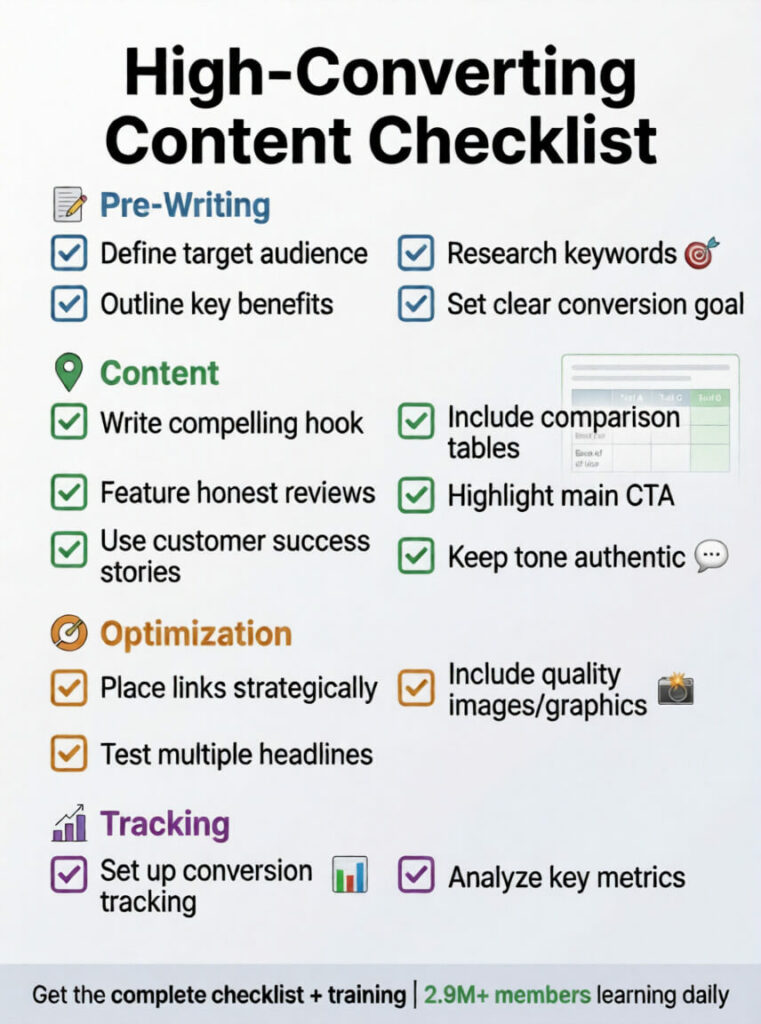
The Complete High-Converting Content Checklist
Before you publish any affiliate content, run through this checklist:
Pre-Writing:
– Researched buyer-intent keywords
– Tested the product personally
– Identified target audience pain points
– Outlined specific sections and flow
Writing:
– Conversational, “you/I” language
– Led with solution, not problem
– Included personal experience/examples
– Listed both pros and cons honestly
– Created comparison table (if applicable)
– Used specific numbers, not vague claims
– Addressed common objections
– Added Quick Verdict box at top
Visuals:
– Included screenshots of product
– Added results/proof images
– Used annotated images with arrows
– Featured image is eye-catching
Affiliate Links:
– 3-5 strategic link placements
– Links are contextual, not spammy
– Clear CTAs (“Try free,” “Get started,” etc.)
– Disclosed affiliate relationship
Optimization:
– Optimized for target keyword
– Meta title and description compelling
– Internal links to related content
– Formatted for easy scanning (headers, bullets)
– Mobile-friendly formatting
Real Example: High-Converting vs Low-Converting Content
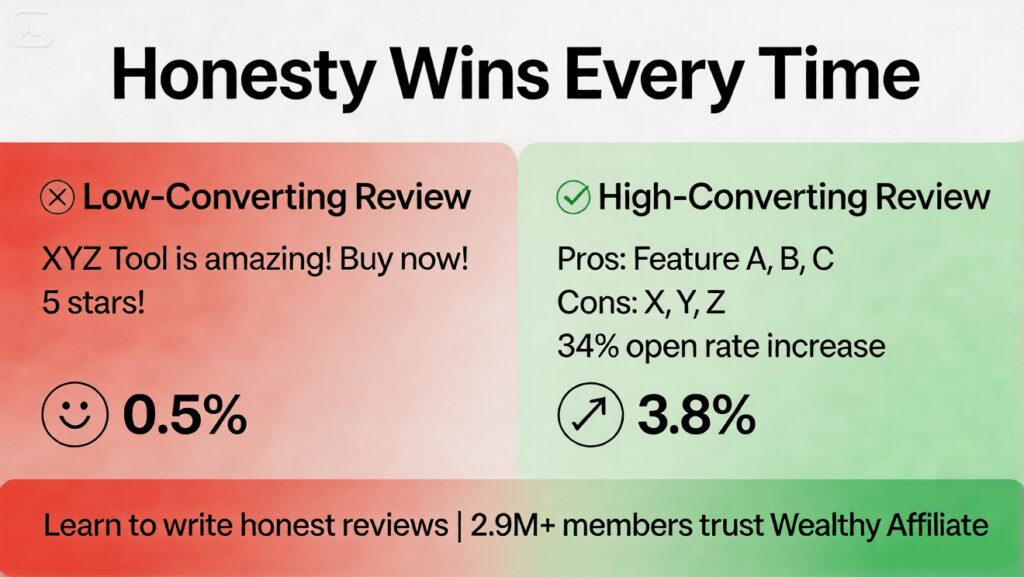
Low-Converting Review:
“ConvertKit is a great email marketing tool. It has lots of features like automation and landing pages. The interface is nice. You should try it. Buy now!”
Why It Fails:
– Generic, could be about any tool
– No proof or evidence
– No specific details
– Reads like an ad
– No trust-building
High-Converting Review:
“I switched from MailChimp to ConvertKit 2 years ago, and my open rates jumped from 24% to 34%. Here’s a screenshot of my last 10 campaigns averaging 33.7% opens.
The automation is what sold me. I set up a 7-email welcome sequence that runs on autopilot. New subscribers get my best content, and I get a 12% click rate on my affiliate links in that sequence.
Pros:
– Super easy to set up forms and automations
– Clean, distraction-free interface
– Amazing customer support (replies in under 2 hours)
– Made for creators, not corporations
Cons:
– More expensive than MailChimp ($29 vs $13/mo)
– Advanced features require learning curve
– No free plan (but they have a 14-day trial)
My verdict: If you’re a blogger or creator and value simplicity over advanced features, ConvertKit is worth the extra $16/month. If you’re on a tight budget or need enterprise-level automation, look at ActiveCampaign instead.
[Try ConvertKit free for 14 days →](link)”
Why It Converts:
– Specific results (24% to 34% opens)
– Personal experience (2 years of use)
– Proof (screenshot mentioned)
– Honest pros and cons
– Clear recommendation
– Alternative suggested
Common Mistakes That Kill Conversions
Mistake #1: Being Too Salesy
“THIS IS THE BEST PRODUCT EVER! BUY NOW!!!”
→ Fix: Be helpful, not pushy
Mistake #2: Promoting Everything
Linking to 50 different products in one article
→ Fix: Focus on 2-3 main recommendations
Mistake #3: No Personal Experience
Reviewing products you’ve never used
→ Fix: Only promote what you’ve actually tested
Mistake #4: Ignoring Mobile Readers
Huge walls of text, no formatting
→ Fix: Short paragraphs, lots of headers
Mistake #5: Burying the Link
Affiliate link only at the very bottom
→ Fix: 3-5 strategic placements throughout
Mistake #6: No Trust-Building
Just features, no personal stories or proof
→ Fix: Share your journey and real results
Mistake #7: Forgetting the CTA
Great content but no clear next step
→ Fix: Tell readers exactly what to do next
Tools You Need to Create High-Converting Content
Content Creation:
– Grammarly – Grammar and clarity checking
– Hemingway App – Readability improvement
– Canva – Creating graphics and featured images
Keyword Research:
– Wealthy Affiliate Keyword Tool – Find buyer keywords (Free to start)
– Ahrefs – Advanced keyword research ($129/mo)
– AnswerThePublic – Question-based keywords (Free)
Screenshots & Images:
– Snagit – Screenshot annotation ($50 one-time)
– CloudApp – Quick screenshots (Free)
– Loom – Screen recording for demos (Free)
Analytics:
– Google Analytics – Track traffic and behavior (Free)
– Pretty Links – Track affiliate link clicks (Free)
– MonsterInsights – GA integration for WordPress ($99/year)
Your Action Plan: Next 7 Days
Don’t just read this guide and do nothing. Here’s your week-by-week action plan:
Day 1-2: Research
– Find 3 buyer-intent keywords in your niche
– Identify products you’ve actually used
– Read 5 top-ranking affiliate reviews for structure ideas
Day 3-4: Outline
– Choose your best product/topic
– Create detailed outline using tips from this guide
– Screenshot product features and your results
Day 5-6: Write
– Write your first draft (2,000+ words)
– Add comparison tables and images
– Place 3-5 affiliate links strategically
Day 7: Publish & Promote
– Optimize meta title/description
– Run through the checklist above
– Publish and share on social media
– Set a reminder to check analytics in 2 weeks
Repeat this process monthly. 12 months = 12 high-quality affiliate articles.
Final Thoughts: Content Quality Over Quantity
I’ve seen affiliates publish 5 articles per week with $0 results.
I’ve also seen affiliates publish 1 article per month and make $2,000+.
The difference? The quality and strategy behind the content.
Focus on these 15 tips:
1. Target buyer-intent keywords
2. Lead with solutions
3. Use Experience-Evidence-Offer framework
4. Write conversationally
5. Be honest about cons
6. Add comparison tables
7. Use specific numbers
8. Include screenshots
9. Address objections upfront
10. Place links strategically
11. Create Quick Verdict boxes
12. Match content to buyer stage
13. Use micro-commitments
14. Add bonuses
15. Test and optimize
Your homework: Go back and audit your existing affiliate content. Which of these 15 tips are you missing? Fix one article per week using this framework.
High-converting content isn’t magic. It’s a system. Follow this system, and your affiliate income will grow.
Want to Learn More About Affiliate Marketing?
This guide covered content creation, but there’s so much more to affiliate marketing success:
Related Articles:
– How to Build a Sustainable Affiliate Marketing Business
– 11 Top Affiliate Programs to Join in 2026
– Wealthy Affiliate Review: 10 Years of Honest Experience
– How to Choose a Profitable Niche for Affiliate Marketing
Get Complete Training:
If you’re serious about building an affiliate business, I recommend [Wealthy Affiliate].
What you get:
– Step-by-step content creation training
– Keyword research tools (find those buyer-intent keywords)
– Website hosting included
– 2.9M+ member community for feedback
– Weekly live training on what’s working NOW
**Start free** (no credit card required):